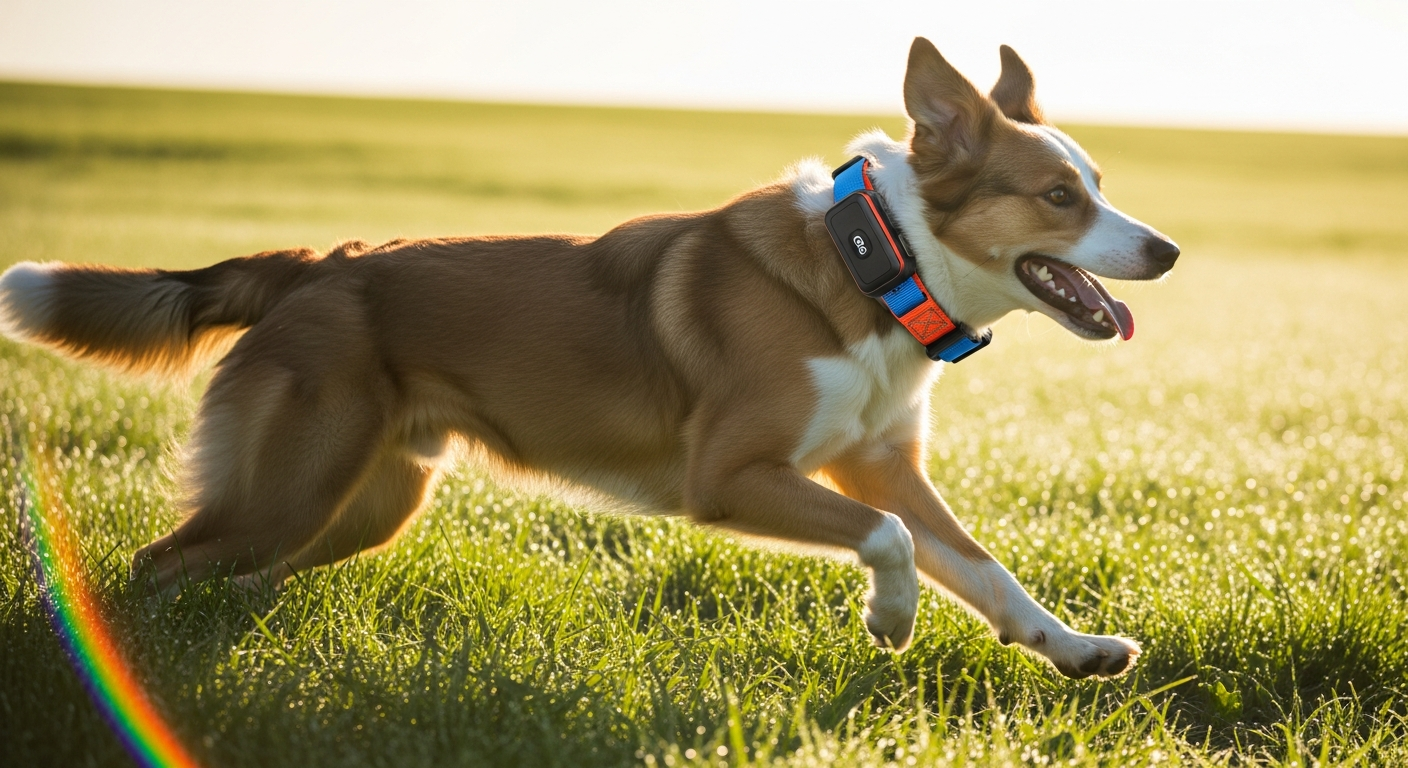
The Tractive LTE is the most-sold dog GPS tracker in Europe and is gaining rapid ground in the US market as an alternative to the Fi Series 3 and the Garmin T5. Its pitch is simple: cellular GPS tracking for dogs at roughly half the upfront hardware cost of Fi, with a broader network coverage footprint. After eight weeks of testing the Tractive LTE on two dogs (my Border Collie Koda and a neighbor's Lab, Finn), I have a clear picture of where the device excels, where it compromises, and who should consider it.
This is not a paid review. Tractive did not supply the unit; I purchased it directly from the company's US storefront. The subscription on both units is the basic "Premium" tier at $8 per month on the annual plan. All testing took place in the San Jose Bay Area, with two additional test trips to coastal forest areas north of Monterey.
Hardware and Build
The Tractive LTE is a clip-on tracker that attaches to an existing collar via a heavy plastic strap. The main unit measures approximately 71 x 29 x 17 mm and weighs 35 grams. Compared to the integrated Fi collar, the Tractive is noticeably more obtrusive on a short-necked dog; on Koda it fits acceptably, but on a smaller dog (under 20 pounds) it would look and feel oversized. The device is rated IPX7, which means it survives brief immersion up to 1 meter for up to 30 minutes. In practice, both test units survived multiple muddy creek swims without issue.
Charging is via a proprietary magnetic pogo pin connector that clips to the back of the unit. You do need to remove the device from the collar to charge it, which is a real inconvenience compared to the Fi. The charging cable is flimsy; Tractive sells replacements at $15. Buy a spare with the initial purchase if you expect to rely on the device long term.
GPS Accuracy
I tested positional accuracy using the same methodology described in our GPS accuracy comparison: recorded sample points against a handheld Trimble receiver across three environments (open field, suburban, urban canyon).
In open field, the Tractive LTE averaged 4.9 meters of error across 200 sample points, with a 95th percentile of 9.1 meters. This is respectable but clearly below the Fi Series 3 (3.2 m average). In suburban testing, Tractive averaged 6.8 meters; in urban canyon, 10.4 meters with a 95th percentile of 19.7 meters. Practically, this means that in a suburban park Tractive will place your dog within 20 to 25 feet of its real location 95 percent of the time, which is adequate for most real-world recovery scenarios but meaningfully less precise than Fi.
The tracker supports live tracking mode (2 to 3 second updates) during active recovery; under battery pressure this shortens battery life dramatically, as discussed below.
Battery Life
Advertised up to 7 days, actual battery life depends heavily on GPS polling frequency and cellular signal strength. In my testing with default "Power Saving" mode and typical daily use, I saw 4 to 5 days between charges. In "Live Tracking" mode during an actual recovery simulation, the battery drained from 100 to 30 percent in 90 minutes. For dogs that escape rarely, 4 to 5 days is good. For owners in high-escape-risk scenarios (new rescue dogs, recent moves, dogs with established escape patterns), consider charging daily.
A key gotcha: the Tractive unit does not include a charging dock. It ships with a 1-meter USB-C cable and the magnetic connector only. You provide your own wall adapter. See our battery life comparison for head-to-head numbers.
App Experience
The Tractive app is clean and functional but not as polished as the Fi app. Map loading is slightly slower, and the location updates on screen feel more "step-wise" than the smooth animation Fi offers. The core features (geofence setup, live tracking, location history) all work reliably. I did not miss any geofence breach notifications during testing.
Notable app features worth highlighting:
- Unlimited live tracking. Unlike some competitors, Tractive does not cap the duration of live tracking within a subscription period.
- Family sharing. You can share device access with up to 5 family members, and all can receive notifications simultaneously. The Fi app is more limited on shared access.
- Heatmap of dog's outdoor time. A nice visualization of where your dog has spent time over days or weeks, useful for owners whose dogs roam rural properties.
- Location history retention. The Premium tier retains 365 days of history. Fi retains 90 days.
Features I wish were better: activity tracking is present but rudimentary compared to Fi's sleep quality and activity scoring; geofence shape options are circle-only (Fi also offers polygonal zones on Premium tiers); the iOS widget options are limited.
Cellular Network and Coverage
Tractive uses Verizon in the US, compared with Fi's AT&T. In the San Jose Bay Area, both networks had reliable coverage in my testing locations. The operational difference emerged during a coastal trip: at a rural trailhead north of Monterey where the Fi unit briefly lost coverage, the Tractive maintained a connection. This matches published coverage data showing Verizon with generally stronger rural coverage than AT&T in the western US. If you travel to rural areas regularly, check both networks' coverage maps against your usual destinations. The FCC's National Broadband Map is a useful general reference, though actual cellular coverage varies by carrier.
Subscription Costs
Tractive requires a subscription for GPS functionality. Pricing for US customers at time of writing:
- Monthly: $13
- Annual: $96 ($8 per month effective)
- 2-year: $144 ($6 per month effective)
- 5-year: $300 ($5 per month effective)
The 5-year tier is the best value if you expect to keep the device long-term, though there is some risk that the hardware breaks or the company changes pricing structure before the full term elapses. Our subscription costs comparison has the head-to-head numbers across Fi, Tractive, Jiobit, and Whistle.
Pros and Cons
What Works
- Lower hardware cost than Fi ($50 vs $149)
- Verizon cellular has strong rural coverage
- Unlimited live tracking
- 365-day location history on Premium
- Family sharing up to 5 members
- Adequate GPS accuracy for most real-world recovery scenarios
Compromises
- Less precise GPS than Fi (~5m vs ~3m open sky)
- Clip-on form factor bulkier than integrated collar
- Charging requires removing tracker from collar
- Flimsy charging cable
- App is functional but less polished than Fi
- No AirTag-style Bluetooth fallback if cellular fails
Who Should Buy It
The Tractive LTE is the right choice for: rural and suburban owners whose dogs are occasional escape artists but not daily flight risks; budget-sensitive households that want cellular GPS without the Fi premium; owners of larger dogs where the clip-on form factor does not create fit issues; and anyone who needs reliable Verizon coverage. Households with multiple dogs may also appreciate that the hardware cost saving scales per dog.
The Tractive is not the right choice for: owners of very small dogs (bulk and weight are too much); owners in dense urban environments where GPS accuracy matters most; or people who will not tolerate a less-polished app. For herding breeds and working dogs specifically, see our GPS tracker herding dogs buying guide, which factors in sprint-escape scenarios where faster GPS fix time matters.
Compared to Fi and Garmin
The Fi Series 3 is the premium option: better accuracy, smoother app, integrated collar, and faster geofence notifications. Worth the price for owners who prioritize polish and precision. Our Fi Series 3 review covers the details. The Garmin T5 is a different category entirely: it is a long-range radio tracker (not cellular) designed for working dogs in rural environments where cellular coverage is unreliable. If you train and hunt with dogs in remote areas, Garmin remains the right tool and no cellular device can replace it. Consumers who do not need radio range should choose between Fi and Tractive, not consider Garmin.
Bottom Line
After eight weeks, my verdict is that the Tractive LTE delivers about 85 percent of the Fi experience for half the hardware cost, with better rural coverage and longer history retention, offset by slightly less precise GPS and a bulkier form factor. For most dog owners, it is an honest value choice. For edge cases (very small dogs, dense urban environments, competitive-grade tracking), the Fi remains the better purchase. For a full feature matrix, see our best GPS trackers roundup and the framework we use to evaluate trackers in cellular vs bluetooth trackers.
The American Veterinary Medical Association's microchipping guidance is worth reading alongside any GPS tracker purchase, because a GPS device supplements but does not replace permanent identification for lost dog recovery.